Better Translators Won't Fix Your Translation Costs. Better Source Content Will.
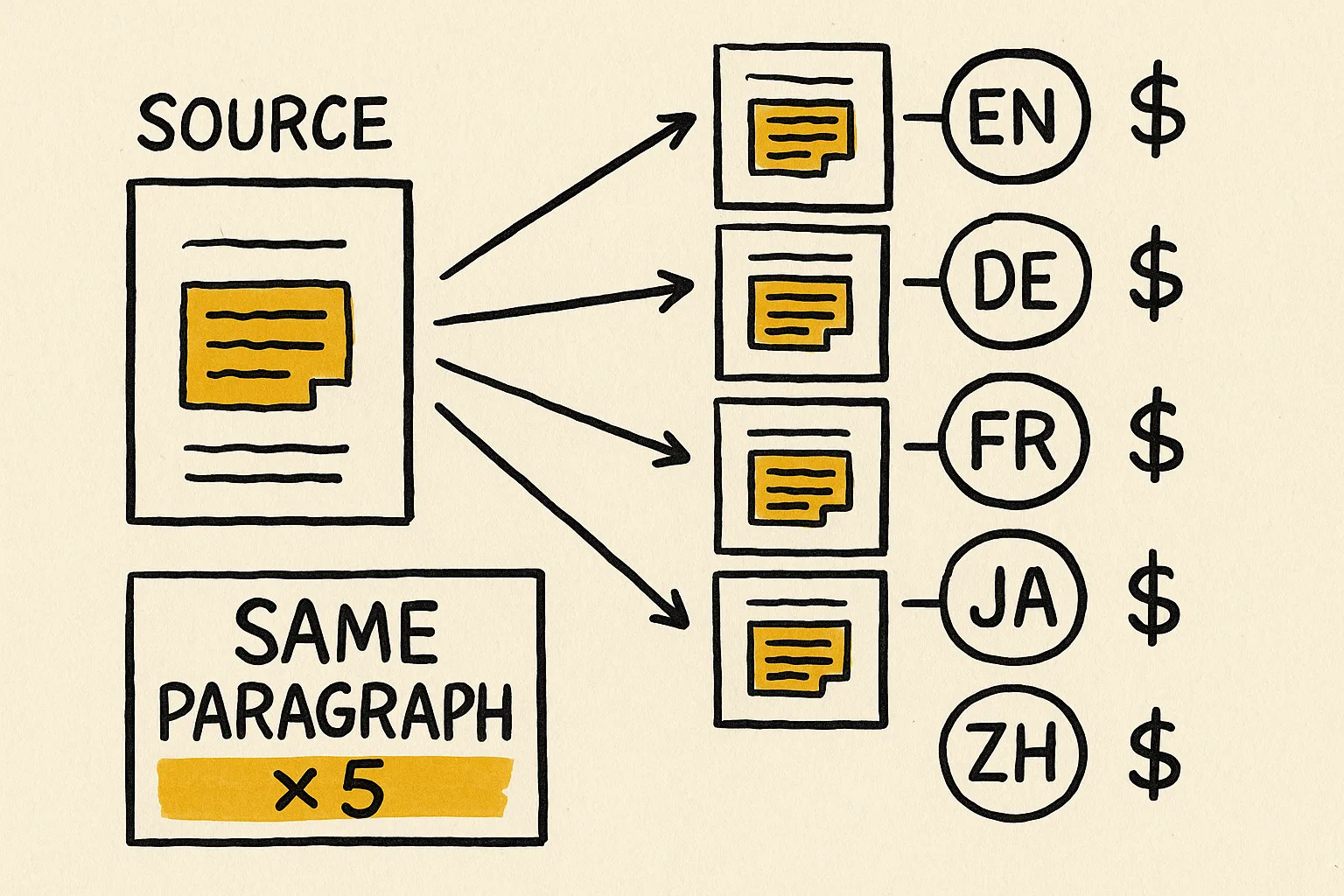
Every language you add multiplies every flaw in your source content.
A localization audit that quantifies TM leverage, structural restructuring that maximizes reuse, and pipeline engineering that automates the handoff. Each new language costs less, not more.
The cheapest translation is the one you don't have to do
You've negotiated with vendors. You've changed agencies. You've tried machine translation. The savings keep evaporating because the source content keeps defeating Translation Memory — irregular sentences, inconsistent reuse, embedded formatting.
"I keep getting blamed for translation budget overruns. The actual problem is upstream and I can't prove it." Better source structure beats better translators every time.
How Localization Costs Cascade
Inconsistent source structure defeats translation memory matching
Low TM leverage means more content sent for full translation — costs rise with each language
Translators compensate differently per language — quality varies unpredictably
Review cycles expand as language-specific fixes pile up
Terminology drifts across languages — customer confusion and support burden grow
Imagine adding language 10 cheaper than you added language 3
We run a 1–2 week localization audit that quantifies your current TM leverage and projects savings before any restructuring begins. Then we optimize source content for maximum reuse and engineer the authoring-to-translation pipeline so the handoff is automated.
TM leverage rises. Per-language costs drop. Terminology stays consistent across all languages. Most teams see measurable cost reduction in the next translation cycle.







What We Deliver
Localization Audit
Analyze your source content for translation efficiency — sentence structure, reuse patterns, terminology consistency, and TM leverage potential.
Architecture Optimization
Restructure content for maximum translation memory reuse and consistent terminology across all target languages.
Pipeline Engineering
Automate the handoff between authoring and translation — reducing manual steps, errors, and turnaround time.
Team Training
Train your writers and localization team on authoring patterns that maximize translation efficiency from day one.
How We Work
Book a call
30 minutes to understand your content, languages, and translation workflow.
Localization audit
Quantify TM leverage, identify structural inefficiencies, and show potential savings.
Structural optimizations
Targeted changes so each new language costs less — not more.
Common Questions
What if this doesn't actually reduce our translation costs?
The first step is a localization audit that quantifies your current TM leverage and identifies specific structural inefficiencies. You'll see the potential savings before any restructuring begins. If the numbers don't justify the work, we'll tell you.
Can we handle this internally?
You can — if your team has localization engineering experience alongside Flare expertise. Most teams have strong writers but limited structural optimization skills. We bring the engineering lens that turns good content into efficiently translatable content.
How long does this take?
A localization audit typically takes 1–2 weeks. Structural optimization depends on content volume, but most teams see measurable cost reduction within the next translation cycle after implementation.
What does this cost?
Typical engagements start at $5,000, depending on content volume and number of target languages. Book a call and we'll give you a concrete estimate — the audit alone often pays for itself in the first translation round.
Be the lead who turned localization from a cost center into a scalable system.
From $5,000 · Audit pays for itself in the first translation round · ROI in the next cycle.
30 minutes. No commitment. Let's discuss your localization challenges.