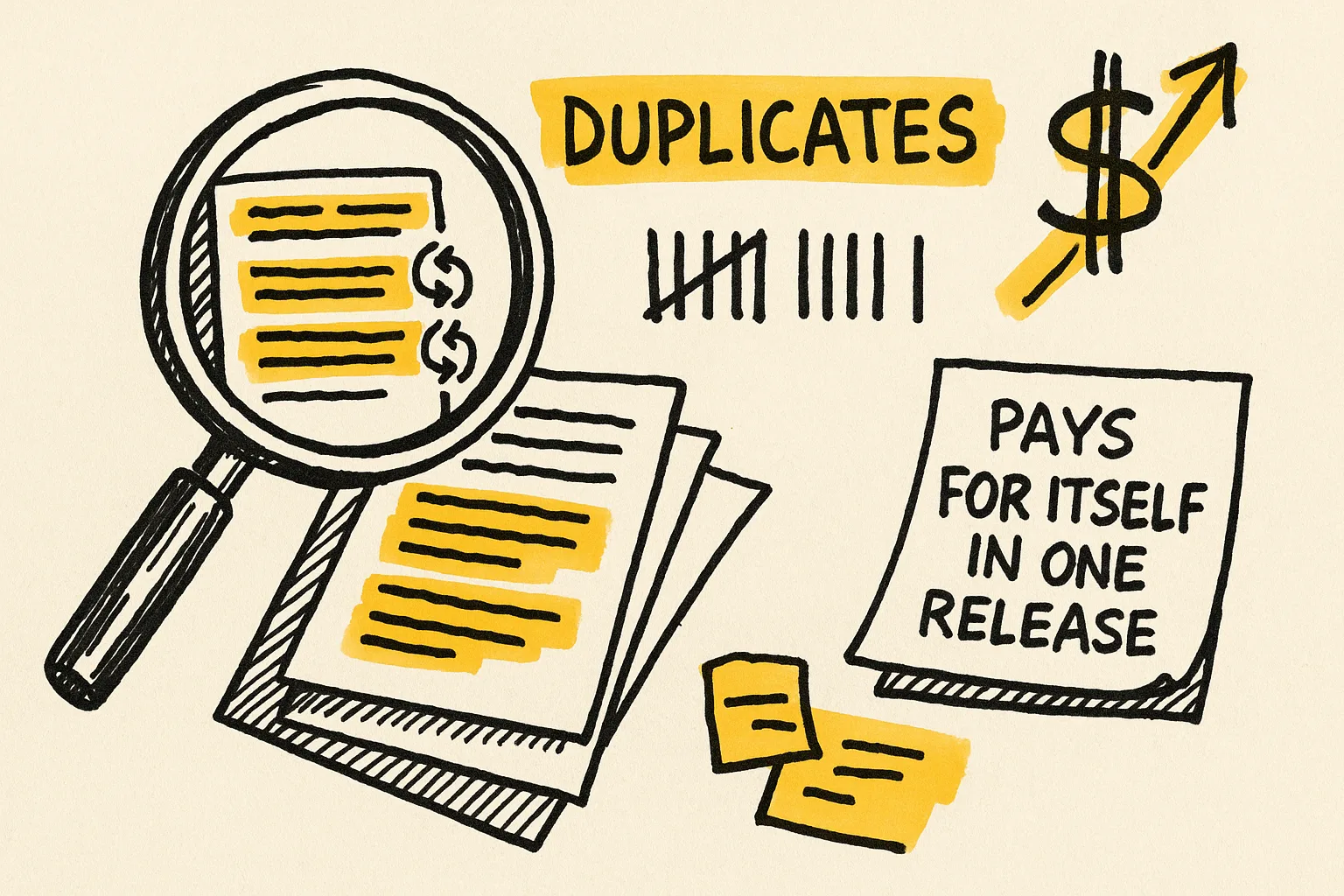
You're Paying Full Price to Translate the Same Content Over and Over
Most teams waste 20–40% of their localization budget on duplicate content they don't even see.
Translation Memory only saves you money when content is identical. If your documentation says the same thing in slightly different ways, it doesn't match — and you pay full price every time. Translation Memory reduces duplication. It does not fix it.
Most companies invest in translation tools to avoid paying twice. We help you avoid paying once unnecessarily.
The problem is quiet, expensive, and common
Same instructions written differently across pages. Slight wording changes between product variants. Repeated procedures with minor variations.
It looks harmless. But for translation, "almost identical" means 100% cost. Your Translation Memory can't match what isn't consistent — and you're paying full price for content that should have been free.
What this looks like in practice
If you have 500,000 words with 30% near-duplicates, that's 150,000 words that say the same thing in slightly different ways. Translation Memory can't match them — so each variant is translated separately, across every language.
At €0.14/word across 5 languages, that's up to €105,000 in translations that could have been free — if the source had been consistent.
And every time content is updated, new variants appear that TM can't match again.
How Duplication Costs Multiply
Writers describe the same procedure in slightly different ways across topics
Translation Memory sees each variant as unique — no matches, no savings
Every language multiplies the wasted translation spend
Content drifts further apart over time as updates hit different copies
Costs compound with each translation cycle while the root cause stays hidden
Visibility first, then cost elimination
Before you invest in rewriting, tooling, or localization changes — understand where the real cost is coming from. A Translation Cost Leak Audit gives you the numbers: exact word counts of non-reusable content, estimated cost per translation cycle, and impact across all languages.
Not theory. Actual examples from your content, with a prioritized list of where to fix first.








What's in the Report
Duplication Map
Every cluster of similar-but-not-identical content identified across your documentation set.
Cost Impact
Word counts of non-reusable content and estimated translation cost per cycle — across all target languages.
Hotspot Ranking
Folders and topics ranked by duplication impact. See exactly where to focus first.
Fix Recommendations
Specific consolidation opportunities, snippet candidates, and reuse suggestions — with examples from your content.
How It Works
Send your files
Upload your documentation set. We handle Flare projects, DITA, structured HTML, and most formats.
We run the analysis
Automated duplication detection, cluster analysis, and cost estimation across your entire content set.
You get the report
A complete duplication report with findings, cost impact, and prioritized recommendations you can act on immediately.
Common Questions
How is it priced?
Fixed price per file in your documentation set. You know the cost upfront before you commit. No hourly rates, no surprises.
What if our duplication isn't actually costing us that much?
Then the report will show you that — and you'll have a baseline for future content decisions. Most teams discover 20–40% of their translation budget goes to content that could have been reused.
Is this a content rewrite?
No. You're not buying editing, migration, or tooling. You're buying a cost reduction report that shows exactly where your localization budget is leaking — and what to fix first. Implementation is up to you.
What formats do you support?
We work with MadCap Flare projects, DITA, structured HTML, and most documentation formats. If you can export it, we can analyze it.
How fast do I get the report?
The analysis is automated. Turnaround depends on the size of your documentation set, but most reports are delivered within days — not weeks.
Who is this for?
Teams translating documentation into multiple languages, companies with growing or fragmented doc sets, and anyone relying on Translation Memory for cost control.
Be the lead who turned localization waste into a board-level win.
Fixed price per file. Days, not weeks. Hand finance a numbered, prioritized cost-leak map.